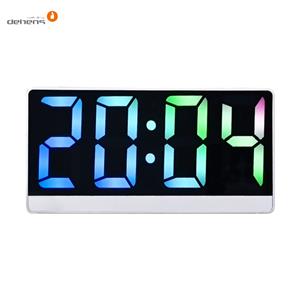
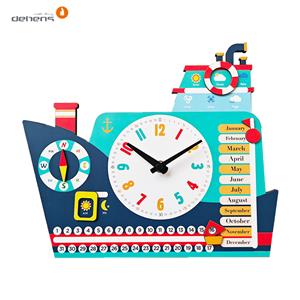
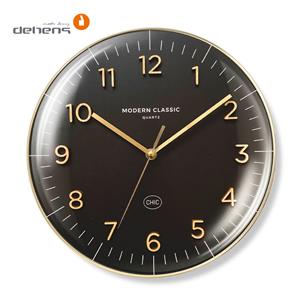
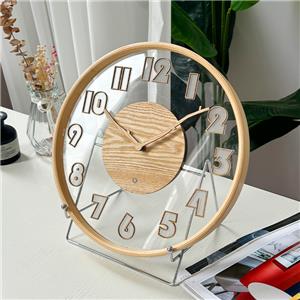
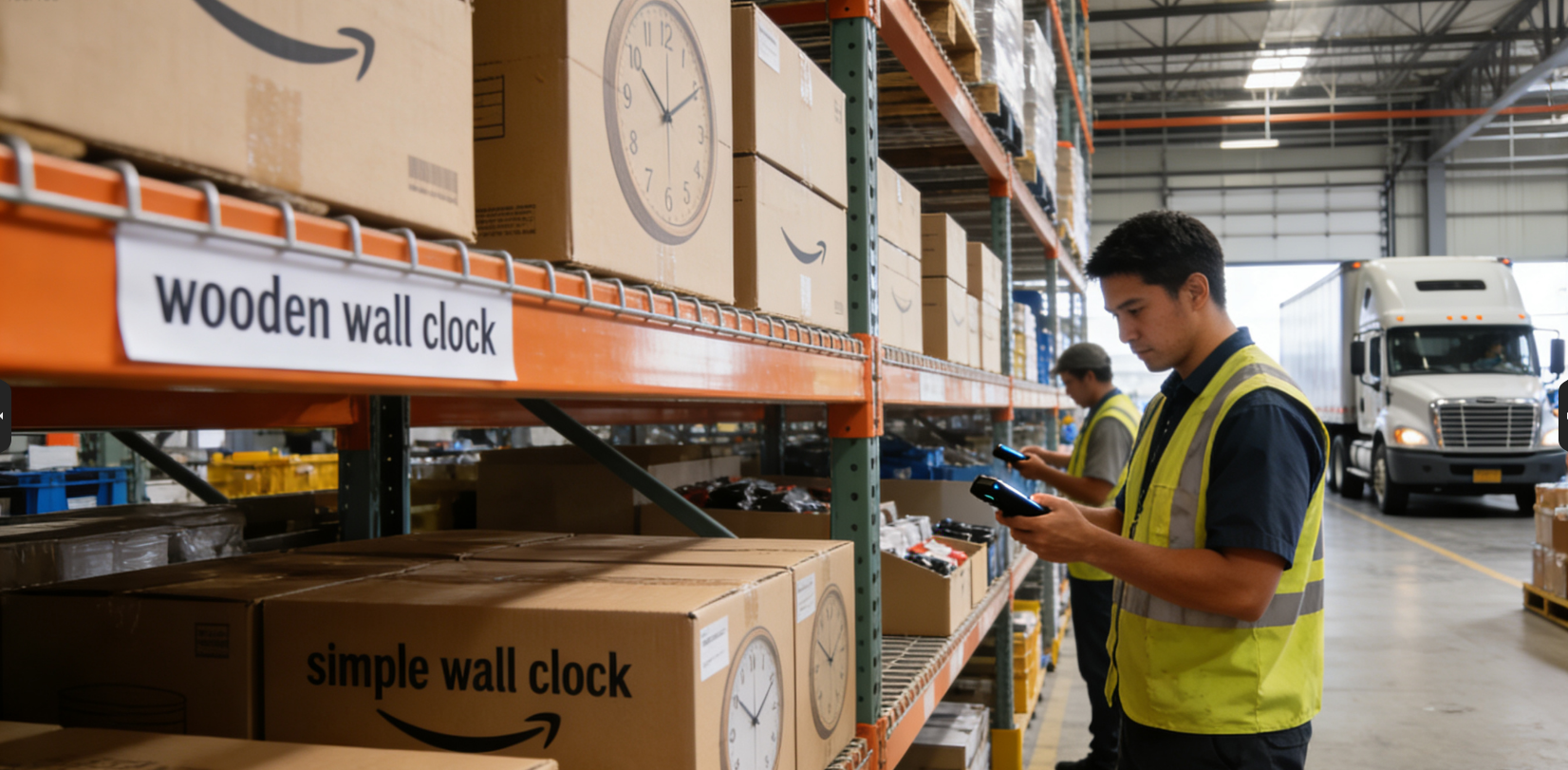
Walk into any home goods section of an Amazon warehouse in Ontario, California, and you’ll spot stacks of cardboard boxes labeled with “wooden wall clock” and “simple wall clock”—many of them destined for front porches across the U.S. by the end of the week. This scene wasn’t common five years ago, but in 2025, the wall clock category has become one of cross-border e-commerce’s most surprising success stories, driven largely by the rise of AI tools that let small sellers compete with big brands, and a festival-driven demand for gifts that feel personal.
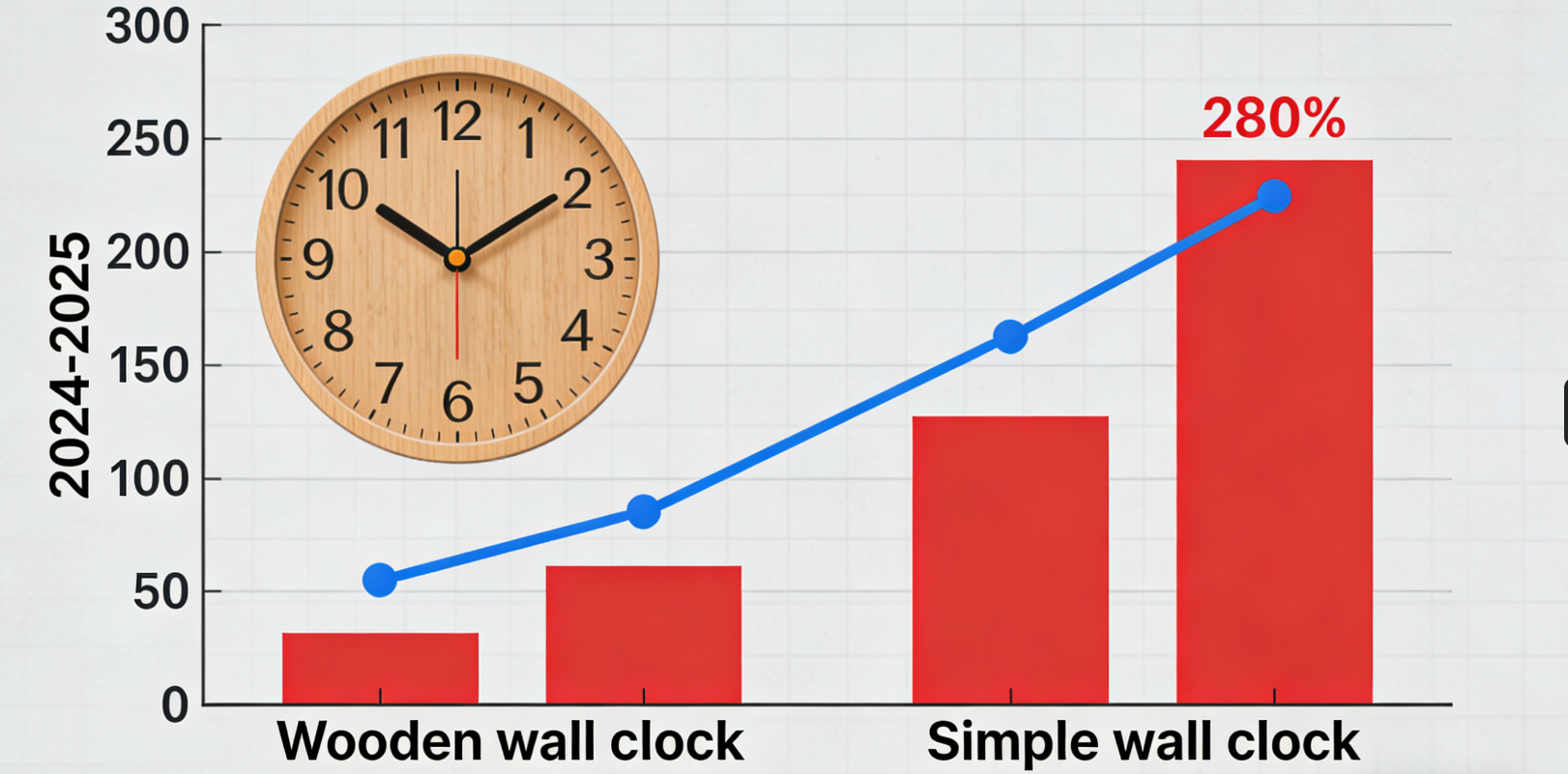
Market data from eMarketer backs up the trend: home decor now ranks in Amazon’s top 5 best-selling categories, grabbing 10.4% of total sales. Within that, wall clock sales are up 67% year-on-year—far outpacing the 42% growth of the broader home goods sector. The amazon hot sale wall clock list tells the clearest tale: wooden wall clock and simple wall clock have held top 10 spots for 18 months straight, with top models moving more than 200 units a day around Father’s Day, Halloween, and Christmas.
clock hasn’t just been a timekeeper for years, but 2025 is the first time wooden wall clock and simple wall clock have truly crossed over into “must-have” territory for overseas shoppers. They’re not just hanging in kitchens or offices—they’re wrapped as gifts for dads, used as Halloween decor, and even mounted in boutique cafes. The growth isn’t random, either: it’s fueled by two things that small sellers never had easy access to before: AI that simplifies everything from design to listings, and marketing that hones in on exactly what shoppers want for holidays. Together, these two forces turned wooden wall clock from a niche item gathering dust in warehouses into a cross-border hit.
AI Revolution: How Small Sellers Broke Into the Wall Clock Market
Li Jin still remembers the first time she tried to launch a wooden wall clock line back in 2023. The 24-year-old from Ningbo, China, spent three months saving up to hire a designer for product sketches, then another two weeks working with a photographer to get usable images. By the time she wrote a basic English listing (with help from a friend who studied abroad), the trend she’d been chasing—rustic wooden decor—had already faded. She sold 12 units total before giving up.
Two years later, everything’s different. Li now runs a one-woman wooden wall clock store on Amazon that moved 20,000 units in its first four months, bringing in $350,000 in revenue. The difference? AI tools that cut through the red tape that used to block small sellers like her.
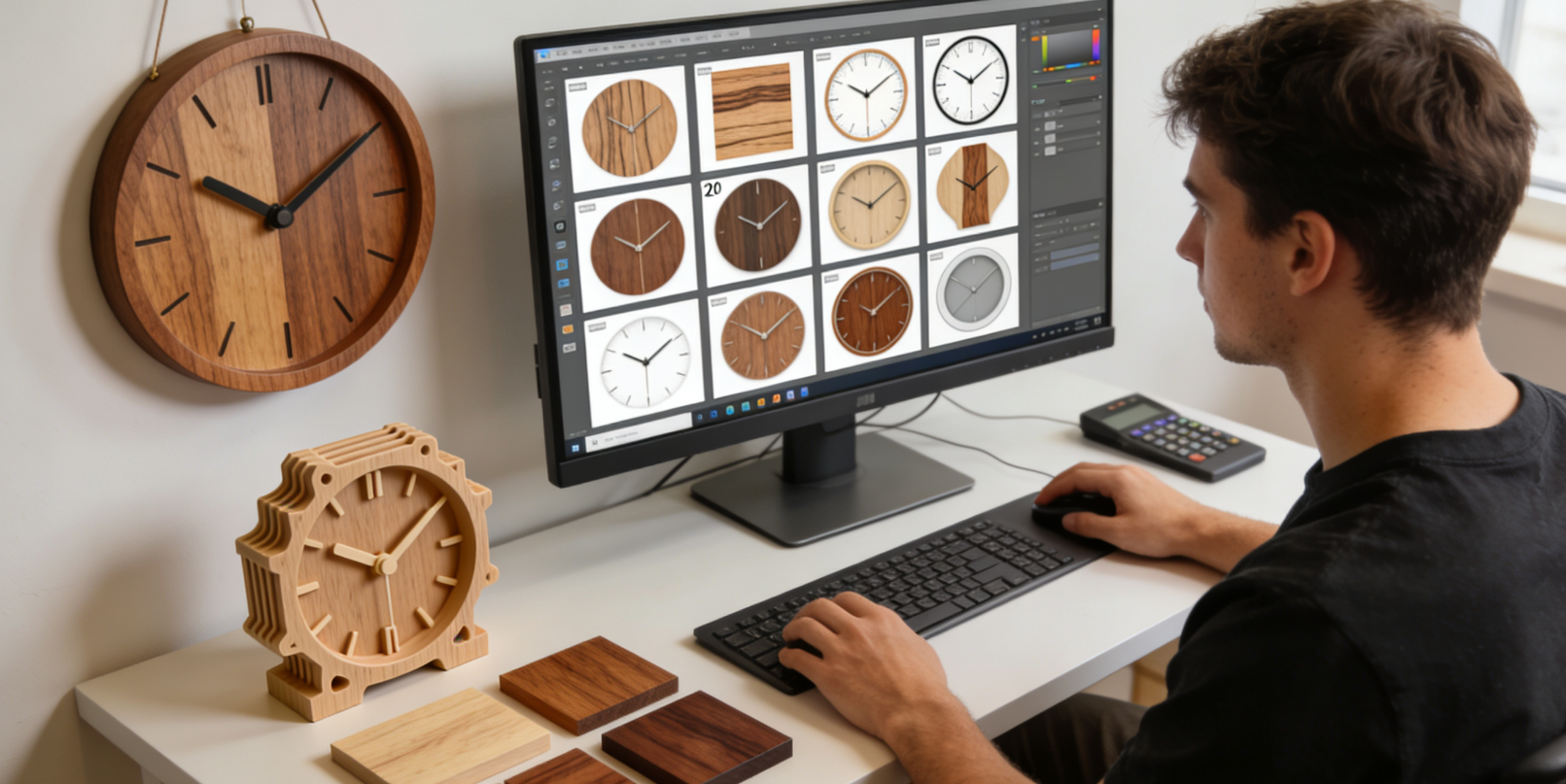
“Before, I needed a team just to get one product up,” Li says, sitting in her home office surrounded by samples of oak and walnut wooden wall clock frames. “Now, I use an AI tool to look at what people are saying in reviews—things like ‘I want a vintage design but with space for a photo’ or ‘the last wooden clock I bought warped in humidity’—and it tells me exactly what to make. I can generate 20 different prototypes in a day, test which ones look best with different wood grains, and never pay a designer.”
Product photos, once a major expense, are now done in hours. Li types prompts into an AI image generator—“rustic wooden wall clock hanging above a beige linen sofa in a Scandinavian living room, soft morning light through sheer curtains”—and gets back studio-quality shots that highlight the natural grain of the oak. She used to pay $500 for a half-day photoshoot with a professional and props; now it’s free, and she can tweak the background to match seasonal trends—adding a fall throw pillow in October or a Christmas wreath in December—if a customer mentions something in a review.
Copywriting, her biggest fear before, is now straightforward too. AI tools write product titles and descriptions that include keywords shoppers actually search for: “handmade wooden wall clock with photo engraving,” “custom engraved clock for dad,” “quiet movement simple wall clock for bedroom.” Li still edits them to sound more natural—she swaps “utilizes a silent quartz movement” for “uses a quiet quartz movement” and adds small details like “perfect for your dad’s man cave or home office” to make listings feel human—but the heavy lifting is done in minutes.
She’s not alone. A survey from the Cross-Border E-Commerce Association found that 68% of wall clock sellers who used AI in 2025 cut their operational costs by 40% or more, and 55% saw sales jump compared to 2024. Launch times have shrunk from two weeks to three days, which matters when trends pop up fast—like the sudden demand for “minimalist simple wall clock with LED backlighting” this past spring, spurred by TikTok videos of people using them in home offices. Li noticed the search spike on a Tuesday morning, adjusted her design by Thursday (adding a dimmable LED ring around the dial), and had the new simple wall clock listed by the weekend. By the end of the month, it was her top-seller, moving 1,200 units.
Festival Marketing: Why Wooden Wall Clocks Became Holiday Must-Haves
Last Father’s Day, Sarah Miller, a mom in Chicago, spent three hours scrolling Amazon for a gift for her husband. She didn’t want another tie or grill tool—she wanted something that felt personal, something that wouldn’t end up in a drawer. She found it in a wooden wall clock engraved with a photo of their two kids playing baseball and the words “Best Dad, Est. 2018.” She paid $45 (more than she usually spends on Father’s Day gifts) and left a 5-star review: “He hangs it in his home office and shows it off to every client. It’s the first gift he’s ever kept out year-round.”
Stories like Sarah’s are why festival marketing has become the backbone of wooden wall clock sales. Overseas shoppers have always liked giving clock as gifts—they symbolize time spent together, milestones, and cherished memories—but wooden wall clock’s warm, natural look and customizable options have made it the top pick for holidays in 2025.
Amazon’s internal data says search volume for “custom wooden wall clock” jumps 280% year-on-year during festival seasons, and 65% of all wooden wall clock sales are personalized models. Father’s Day is the biggest driver: Li’s engraved “Best Dad Ever” wooden wall clock sold out in 48 hours this year, and she had to rush 500 more units to her California warehouse via air freight—an extra cost, but one that paid off when the rest sold out in three days. She’s not the only one—sales of Father’s Day-themed wooden wall clock were up 190% on Amazon in 2025 compared to 2024, with “photo engraving” being the top searched add-on.
Halloween and Christmas bring their own twists. For Halloween, simple wall clock with pumpkin-shaped dials, bat silhouettes, and glow-in-the-dark hands fly off shelves—parents love them because they’re lightweight (made from durable but soft plastic, no risk of kids knocking them over) and affordable (most sell for 25). Li added a “spooky but cute” design this year with googly eyes that wiggle when the clock ticks, and it became her best-selling simple wall clock for October, moving 800 units. Christmas shifts to elegance: walnut or oak wooden wall clock with snowflake engravings, red ribbon accents, or even small LED lights that twinkle softly. Li even added a “Christmas countdown” model this year, with a small sub-dial that tracks days until December 25—it’s now her second-best seller for the holiday season, with pre-orders starting in November. Independence Day in the U.S. is a sleeper hit that more sellers are catching onto. A Shenzhen-based seller I spoke to, who goes by Mike to make it easier for U.S. customers, launched a wooden wall clock with an American flag design (painted, not printed, for durability) in late May. He ran targeted ads on Instagram and Pinterest—focusing on people who followed “patriotic home decor” or “ Fourth of July party ideas” accounts—and by July 1, the clock was in the amazon hot sale wall clock top 5. “We made $80,000 in 10 days,” Mike says. “People love putting them on their porch or in their garage for barbecues. We even had a fire department order 20 for their station—they wanted something that felt American-made, even if it was designed overseas.”
The customization part is key to repeat business. Mike uses an AI tool on his Amazon listing that lets customers upload photos, pick from 12 font styles, and add text in real time—they can see a preview of the wooden wall clock within 30 seconds. “Before, customization was a hassle—customers had to email me their photo, wait 24 hours for a proof, then approve it,” he says. “Now it’s instant. I get way fewer questions, and repeat buyers are up to 30%—the industry average for home goods is 12%. Sarah Miller, the Chicago mom, already bought a Christmas-themed wooden wall clock from my store after loving the Father’s Day one—she added a family photo from last Christmas.”
Simple Wall Clock: The Minimalist Favorite for Daily Use
While wooden wall clock steals the holiday spotlight, simple wall clock is quietly dominating everyday home use—especially with young shoppers who want decor that doesn’t clutter their small spaces or clash with ever-changing trends. Emma Carter, a 28-year-old in Brooklyn who rents a 500-square-foot apartment, has two simple wall clocks: one in her kitchen (white dial, black hands, 8-inch diameter) and one in her bedroom (gray dial, silent movement, 10-inch diameter). “I don’t have space for anything fancy or bulky,” she says. “These fit on my tiny walls, and they don’t clash with my furniture—whether I’m using a boho rug or a minimalist couch. Plus, the silent one in my bedroom doesn’t keep me up at night, which my old clock did.”
Emma’s not an outlier. simple wall clock has been in the amazon hot sale wall clock top 3 for 12 months straight, with sales up 72% year-on-year. The appeal is uncomplicated: “less is more.” Most models have solid-color dials (white, black, beige, light gray are the top sellers), thin frames (matte metal or smooth plastic), and large, bold numerals that are easy to read from across the room—no curly fonts or decorative flourishes. They don’t have engravings or patterns—just a clean look that works with Nordic, minimalist, boho, or even industrial decor.
Size versatility is another key strength. Small simple wall clock (8–10 inches) fit in kitchens, bathrooms, home offices, or above nightstands—places where space is at a premium. Larger ones (14–18 inches) serve as subtle focal points in living rooms, but they’re still thin enough (usually less than 1 inch deep) to not feel bulky or overwhelming. Amazon Basics sells a popular simple wall clock with a white dial and slim black metal frame that has 15,000 5-star reviews. One customer wrote: “I bought three—one for each room. They’re easy to hang (comes with hardware), keep perfect time, and I don’t have to worry about them going out of style when I redecorate. Worth every penny.”
Sustainability is pushing sales too, as more shoppers—especially millennials and Gen Z—check product labels for eco-friendly materials before buying. Sellers are responding by switching to recycled plastic frames, FSC-certified wood (for simple wall clocks with wooden accents), and water-based paints that don’t emit harsh chemicals. IKEA’s 2025 simple wall clock line, made from 100% recycled ocean plastic (collected off the coast of Indonesia), sold 500,000 units in its first three months—most of them in Europe and North America, where sustainability awareness is highest. “I’ll pay a little more for something that’s not bad for the planet,” Emma says. She bought an eco-friendly simple wall clock for her bedroom (it cost 18 for a non-recycled model) and says she’d choose it again even if the price gap was bigger. simple wall clock isn’t just for homes anymore, either—it’s breaking into commercial spaces. A chain of Scandinavian-inspired cafes called Hygge Haus recently ordered 500 simple wall clocks for its U.S. locations, all in a soft beige color with thin oak frames. “We wanted something that felt calm and modern, that didn’t distract from the coffee or the cozy vibe,” says the chain’s design director, Lila Olsen. “These clocks fit perfectly—they’re visible but not loud. Our customers even ask where to buy them; we’ve started putting a little card with the Amazon link next to the register.” That’s a new revenue stream for sellers: commercial orders now make up 15% of simple wall clock sales, up from 5% in 2024, with cafes, co-working spaces, and boutique hotels leading the demand.
Logistics: How Overseas Warehouses Fixed the Delivery Problem
Two years ago, Mike (the Shenzhen seller) had a customer in Florida who ordered a wooden wall clock for Mother’s Day. The clock shipped from China on April 20, but it got stuck in U.S. Customs for two weeks—delayed by a random inspection of incoming furniture items. By the time it arrived on May 8—three days after Mother’s Day—the customer was so upset she asked for a full refund and left a scathing 1-star review: “Wasted my money on a late gift. Will never buy from this seller again.” “That review hurt my ranking for months,” Mike says. “Amazon’s algorithm punishes low ratings, so my wooden wall clock stopped showing up on the first page of searches. I knew I had to fix delivery if I wanted to grow.”
He’s not the only one who struggled with this. Traditional direct shipping from China to the U.S. or Europe takes 15–30 days, and that’s on a good day—customs delays, weather issues, or shipping carrier backlogs can make it even longer. For holiday gifts, that’s a death sentence: shoppers won’t wait three weeks for a Father’s Day or Christmas present. That’s why more and more clock sellers are turning to overseas warehouses—facilities in target markets where they stock inventory in advance, so when a customer orders, the wooden wall clock or simple wall clock ships locally.
Mike now keeps his top 10 amazon hot sale wall clock models (including his American flag design and best-selling engraved wooden wall clock) in an Amazon FBA warehouse in Dallas, Texas. The difference is night and day: delivery time dropped from 21 days to 3–5 days, and his positive review rate jumped from 4.2 to 4.8 stars out of 5. “Last Mother’s Day, I didn’t get a single complaint about late deliveries,” he says. “Customers even mention fast shipping in their reviews now—things like ‘arrived in two days, perfect for my mom’s gift’—it’s become a selling point, not a headache.”
Overseas warehouses save money too, which lets sellers stay competitive on price. Shipping a single wooden wall clock from China to the U.S. directly costs about 12(includingpackagingandinsurance);shippingfromaU.S.warehousecosts
5differencematters,”hesays.“OnAmazon,shopperscomparepricesfast—ifmyclockis
Customized wooden wall clocks used to be a logistical nightmare—you can’t stock every possible photo engraving or text combination. But now sellers have figured out a hybrid model: they keep blank wooden wall clock frames (already painted and finished) in overseas warehouses, and partner with local small businesses to do the engraving after an order comes in. Li works with a family-owned woodshop in Los Angeles that specializes in laser engraving; when a customer orders a custom wooden wall clock, Li sends the design file to the shop, which engraves the frame and ships it within 48 hours. “It’s a little more work—coordinating with the shop, making sure the designs are correct—but customers love getting their custom clock fast,” she says. “I used to lose 30% of potential sales because people didn’t want to wait three weeks for a personalized gift—now that’s not an issue.”
The impact on search rankings is tangible too. A survey of wall clock sellers conducted by a cross-border e-commerce consulting firm found that those using overseas warehouses have 40% more positive reviews than those who ship directly, and Amazon’s algorithm favors products with fast delivery times. Li’s “Best Dad Ever” wooden wall clock is now the first result when someone searches “Father’s Day wooden wall clock” on Amazon—she says that’s mostly because of her California warehouse and the 4.9-star rating it’s built up from on-time deliveries.
What’s Next: Smart Clocks and Sustainable Designs
Sit in on any cross-border e-commerce conference these days—whether it’s in Shenzhen, New York, or Berlin—and you’ll hear two words repeated over and over: smart and sustainable. These aren’t just buzzwords; they’re the trends shaping the next phase of wall clock sales, and sellers who jump on them early are already reaping the rewards.
Smart wall clocks are the new frontier, blending the classic look of wooden wall clock or simple wall clock with modern tech features. Xiaomi launched a smart wooden wall clock in early 2025 that looks like a traditional oak clock but connects to Wi-Fi (so it automatically adjusts for daylight saving time), has a built-in humidity sensor (it shows the room’s humidity level in small numbers at the bottom of the dial), and works with Alexa and Google Home. You can ask it for the weather (“Alexa, ask the clock what the temperature is”) or set a timer for cooking, and it still uses a quiet quartz movement—no loud beeping or bright screens. It sold 100,000 units in its first month, mostly to tech-savvy shoppers who want smart home gear that doesn’t look like a gadget.
Industry analysts from Forrester Research think smart wall clocks will make up 35% of the cross-border wall clock market by 2027, growing at a 45% annual rate. Li is testing a smart simple wall clock now—she’s added a small, dimmable temperature display at the top of the dial but kept the clean white face and thin frame. “I don’t want to scare off customers who like plain, classic clocks,” she says. “The smart features should be helpful, not flashy. If someone just wants a clock that tells time, they can ignore the display—but if they want to check the temperature before leaving the house, it’s there.”
Sustainability is getting more specific too—shoppers aren’t just satisfied with a vague “eco-friendly” label anymore; they want details about materials, sourcing, and impact. IKEA’s recycled plastic simple wall clock doesn’t just say “made from recycled plastic”—it lists exactly how much plastic is used per clock (1.2 pounds), where the plastic came from (ocean plastic collected by fishing communities off Indonesia), and how much waste it kept out of landfills (each clock diverts 20 plastic bottles from landfills). A Nielsen study found that 73% of millennials and Gen Z will pay 15–20% more for products with this level of transparency—up from 58% in 2020.
Mike is leaning into this with his reclaimed wood wooden wall clock line—he sources old barn wood from Pennsylvania (via a U.S.-based supplier that works with farmers to repurpose old structures) and has it shipped to his Shenzhen workshop, where it’s sanded, sealed, and turned into clock frames. Each clock comes with a small card that tells the story of the barn it came from: “This clock frame is made from wood from a 1920s dairy barn in Lancaster County, Pennsylvania, that was restored in 2024.” “It’s more expensive—reclaimed wood costs twice as much as new oak—but the grain is unique, and customers love the story,” he says. “I had a customer in Vermont who left a review saying she bought one because her family used to own a dairy barn—she wanted something that felt like home. That’s the kind of connection you can’t get with new wood.”
The lines between wooden wall clock and simple wall clock are also blurring, creating a hybrid category that’s growing faster than either alone. Sellers are making “minimalist wooden wall clock**s”—solid wood frames (usually oak or walnut) with clean, unadorned white or black dials, no engravings or patterns. They have the warmth and texture of wooden wall clock but the simplicity of simple wall clock, and sales are up 89% year-on-year in 2025. Emma, the Brooklyn renter, bought one for her living room earlier this year: “I didn’t think I’d like a wooden clock—I thought it would be too rustic—but this one is sleek. The wood makes the room feel cozier, but it doesn’t clash with my minimalist couch. It’s the perfect middle ground.”
For sellers like Li and Mike, the future feels bright—but it’s not without work. They’re constantly testing new designs (Li just ordered samples of a bamboo simple wall clock to see if it resonates with eco-conscious shoppers), tweaking their marketing (Mike is experimenting with short Reels showing how his reclaimed wood clocks are made), and figuring out how to keep up with trends. Li spends an hour every night reading customer reviews on Amazon and TikTok to see what people want next—recent comments have mentioned wanting a “smart wooden wall clock with a USB charger” for phones. Mike is learning about carbon-neutral shipping options so he can add “ships carbon-free” to his listings, a feature he says U.K. customers have been asking for.
Conclusion
Stand in Li’s home office in Ningbo, and you’ll see a whiteboard covered with handwritten notes: “test LED simple wall clock prototype,” “Father’s Day 2026: fishing theme or golf theme?,” “check bamboo supplier prices,” “follow up with LA woodshop re: engraving delays.” It’s a messy, human reminder that the wall clock boom isn’t just about AI algorithms or Amazon trends—it’s about sellers who are paying attention to what shoppers actually want, and using tools to deliver it fast.
In 2025, wooden wall clock and simple wall clock have gone from afterthoughts in the home goods aisle to cross-border stars. They’re not just products—they’re gifts that say “I thought of you” without being cheesy, decor that fits in a 500-square-foot apartment or a 5,000-square-foot house, and even small tools that make daily life a little easier (like checking the humidity or temperature at a glance). For shoppers like Sarah Miller and Emma Carter, they’re solutions to problems they didn’t know they had: a Father’s Day gift that isn’t a tie, a clock that doesn’t keep them up at night, a decoration that feels personal without being cluttered.
For sellers, the lesson is clear: success in cross-border wall clock sales isn’t about having the biggest budget or the fanciest factory. It’s about using tools like AI to listen to customers faster, leaning into holidays to create emotional connections, fixing logistical pain points like slow shipping, and staying ahead of trends like smart tech and sustainability. Li and Mike didn’t become successful because they invented a new kind of clock—they became successful because they made existing wall clocks work better for the way people live now.
As 2025 winds down and sellers start planning for 2026, one thing is certain: the wooden wall clock and simple wall clock boom isn’t slowing down. With more small sellers entering the market (thanks to AI lowering barriers), more shoppers looking for personal, sustainable decor, and more holidays to celebrate, the wall clock will keep ticking as one of cross-border e-commerce’s most surprising and resilient success stories. And for anyone walking into that Amazon warehouse in Ontario, those stacks of wooden wall clock and simple wall clock boxes will keep growing—each one a small piece of a global trend built on listening, adapting, and delivering what people want.
Walk into any home goods section of an Amazon warehouse in Ontario, California, and you’ll spot stacks of cardboard boxes labeled with “wooden wall clock” and “simple wall clock”—many of them destined for front porches across the U.S. by the end of the week. This scene wasn’t common five years ago, but in 2025, the wall clock category has become one of cross-border e-commerce’s most surprising success stories, driven largely by the rise of AI tools that let small sellers compete with big brands, and a festival-driven demand for gifts that feel personal.
Market data from eMarketer backs up the trend: home decor now ranks in Amazon’s top 5 best-selling categories, grabbing 10.4% of total sales. Within that, wall clock sales are up 67% year-on-year—far outpacing the 42% growth of the broader home goods sector. The amazon hot sale wall clock list tells the clearest tale: wooden wall clock and simple wall clock have held top 10 spots for 18 months straight, with top models moving more than 200 units a day around Father’s Day, Halloween, and Christmas.
clock hasn’t just been a timekeeper for years, but 2025 is the first time wooden wall clock and simple wall clock have truly crossed over into “must-have” territory for overseas shoppers. They’re not just hanging in kitchens or offices—they’re wrapped as gifts for dads, used as Halloween decor, and even mounted in boutique cafes. The growth isn’t random, either: it’s fueled by two things that small sellers never had easy access to before: AI that simplifies everything from design to listings, and marketing that hones in on exactly what shoppers want for holidays. Together, these two forces turned wooden wall clock from a niche item gathering dust in warehouses into a cross-border hit.
AI Revolution: How Small Sellers Broke Into the Wall Clock Market
Li Jin still remembers the first time she tried to launch a wooden wall clock line back in 2023. The 24-year-old from Ningbo, China, spent three months saving up to hire a designer for product sketches, then another two weeks working with a photographer to get usable images. By the time she wrote a basic English listing (with help from a friend who studied abroad), the trend she’d been chasing—rustic wooden decor—had already faded. She sold 12 units total before giving up.
Two years later, everything’s different. Li now runs a one-woman wooden wall clock store on Amazon that moved 20,000 units in its first four months, bringing in $350,000 in revenue. The difference? AI tools that cut through the red tape that used to block small sellers like her.
“Before, I needed a team just to get one product up,” Li says, sitting in her home office surrounded by samples of oak and walnut wooden wall clock frames. “Now, I use an AI tool to look at what people are saying in reviews—things like ‘I want a vintage design but with space for a photo’ or ‘the last wooden clock I bought warped in humidity’—and it tells me exactly what to make. I can generate 20 different prototypes in a day, test which ones look best with different wood grains, and never pay a designer.”
Product photos, once a major expense, are now done in hours. Li types prompts into an AI image generator—“rustic wooden wall clock hanging above a beige linen sofa in a Scandinavian living room, soft morning light through sheer curtains”—and gets back studio-quality shots that highlight the natural grain of the oak. She used to pay $500 for a half-day photoshoot with a professional and props; now it’s free, and she can tweak the background to match seasonal trends—adding a fall throw pillow in October or a Christmas wreath in December—if a customer mentions something in a review.
Copywriting, her biggest fear before, is now straightforward too. AI tools write product titles and descriptions that include keywords shoppers actually search for: “handmade wooden wall clock with photo engraving,” “custom engraved clock for dad,” “quiet movement simple wall clock for bedroom.” Li still edits them to sound more natural—she swaps “utilizes a silent quartz movement” for “uses a quiet quartz movement” and adds small details like “perfect for your dad’s man cave or home office” to make listings feel human—but the heavy lifting is done in minutes.
She’s not alone. A survey from the Cross-Border E-Commerce Association found that 68% of wall clock sellers who used AI in 2025 cut their operational costs by 40% or more, and 55% saw sales jump compared to 2024. Launch times have shrunk from two weeks to three days, which matters when trends pop up fast—like the sudden demand for “minimalist simple wall clock with LED backlighting” this past spring, spurred by TikTok videos of people using them in home offices. Li noticed the search spike on a Tuesday morning, adjusted her design by Thursday (adding a dimmable LED ring around the dial), and had the new simple wall clock listed by the weekend. By the end of the month, it was her top-seller, moving 1,200 units.
Festival Marketing: Why Wooden Wall Clocks Became Holiday Must-Haves
Last Father’s Day, Sarah Miller, a mom in Chicago, spent three hours scrolling Amazon for a gift for her husband. She didn’t want another tie or grill tool—she wanted something that felt personal, something that wouldn’t end up in a drawer. She found it in a wooden wall clock engraved with a photo of their two kids playing baseball and the words “Best Dad, Est. 2018.” She paid $45 (more than she usually spends on Father’s Day gifts) and left a 5-star review: “He hangs it in his home office and shows it off to every client. It’s the first gift he’s ever kept out year-round.”
Stories like Sarah’s are why festival marketing has become the backbone of wooden wall clock sales. Overseas shoppers have always liked giving clock as gifts—they symbolize time spent together, milestones, and cherished memories—but wooden wall clock’s warm, natural look and customizable options have made it the top pick for holidays in 2025.
Amazon’s internal data says search volume for “custom wooden wall clock” jumps 280% year-on-year during festival seasons, and 65% of all wooden wall clock sales are personalized models. Father’s Day is the biggest driver: Li’s engraved “Best Dad Ever” wooden wall clock sold out in 48 hours this year, and she had to rush 500 more units to her California warehouse via air freight—an extra cost, but one that paid off when the rest sold out in three days. She’s not the only one—sales of Father’s Day-themed wooden wall clock were up 190% on Amazon in 2025 compared to 2024, with “photo engraving” being the top searched add-on.
Halloween and Christmas bring their own twists. For Halloween, simple wall clock with pumpkin-shaped dials, bat silhouettes, and glow-in-the-dark hands fly off shelves—parents love them because they’re lightweight (made from durable but soft plastic, no risk of kids knocking them over) and affordable (most sell for 25). Li added a “spooky but cute” design this year with googly eyes that wiggle when the clock ticks, and it became her best-selling simple wall clock for October, moving 800 units. Christmas shifts to elegance: walnut or oak wooden wall clock with snowflake engravings, red ribbon accents, or even small LED lights that twinkle softly. Li even added a “Christmas countdown” model this year, with a small sub-dial that tracks days until December 25—it’s now her second-best seller for the holiday season, with pre-orders starting in November. Independence Day in the U.S. is a sleeper hit that more sellers are catching onto. A Shenzhen-based seller I spoke to, who goes by Mike to make it easier for U.S. customers, launched a wooden wall clock with an American flag design (painted, not printed, for durability) in late May. He ran targeted ads on Instagram and Pinterest—focusing on people who followed “patriotic home decor” or “ Fourth of July party ideas” accounts—and by July 1, the clock was in the amazon hot sale wall clock top 5. “We made $80,000 in 10 days,” Mike says. “People love putting them on their porch or in their garage for barbecues. We even had a fire department order 20 for their station—they wanted something that felt American-made, even if it was designed overseas.”
The customization part is key to repeat business. Mike uses an AI tool on his Amazon listing that lets customers upload photos, pick from 12 font styles, and add text in real time—they can see a preview of the wooden wall clock within 30 seconds. “Before, customization was a hassle—customers had to email me their photo, wait 24 hours for a proof, then approve it,” he says. “Now it’s instant. I get way fewer questions, and repeat buyers are up to 30%—the industry average for home goods is 12%. Sarah Miller, the Chicago mom, already bought a Christmas-themed wooden wall clock from my store after loving the Father’s Day one—she added a family photo from last Christmas.”
Simple Wall Clock: The Minimalist Favorite for Daily Use
While wooden wall clock steals the holiday spotlight, simple wall clock is quietly dominating everyday home use—especially with young shoppers who want decor that doesn’t clutter their small spaces or clash with ever-changing trends. Emma Carter, a 28-year-old in Brooklyn who rents a 500-square-foot apartment, has two simple wall clocks: one in her kitchen (white dial, black hands, 8-inch diameter) and one in her bedroom (gray dial, silent movement, 10-inch diameter). “I don’t have space for anything fancy or bulky,” she says. “These fit on my tiny walls, and they don’t clash with my furniture—whether I’m using a boho rug or a minimalist couch. Plus, the silent one in my bedroom doesn’t keep me up at night, which my old clock did.”
Emma’s not an outlier. simple wall clock has been in the amazon hot sale wall clock top 3 for 12 months straight, with sales up 72% year-on-year. The appeal is uncomplicated: “less is more.” Most models have solid-color dials (white, black, beige, light gray are the top sellers), thin frames (matte metal or smooth plastic), and large, bold numerals that are easy to read from across the room—no curly fonts or decorative flourishes. They don’t have engravings or patterns—just a clean look that works with Nordic, minimalist, boho, or even industrial decor.
Size versatility is another key strength. Small simple wall clock (8–10 inches) fit in kitchens, bathrooms, home offices, or above nightstands—places where space is at a premium. Larger ones (14–18 inches) serve as subtle focal points in living rooms, but they’re still thin enough (usually less than 1 inch deep) to not feel bulky or overwhelming. Amazon Basics sells a popular simple wall clock with a white dial and slim black metal frame that has 15,000 5-star reviews. One customer wrote: “I bought three—one for each room. They’re easy to hang (comes with hardware), keep perfect time, and I don’t have to worry about them going out of style when I redecorate. Worth every penny.”
Sustainability is pushing sales too, as more shoppers—especially millennials and Gen Z—check product labels for eco-friendly materials before buying. Sellers are responding by switching to recycled plastic frames, FSC-certified wood (for simple wall clocks with wooden accents), and water-based paints that don’t emit harsh chemicals. IKEA’s 2025 simple wall clock line, made from 100% recycled ocean plastic (collected off the coast of Indonesia), sold 500,000 units in its first three months—most of them in Europe and North America, where sustainability awareness is highest. “I’ll pay a little more for something that’s not bad for the planet,” Emma says. She bought an eco-friendly simple wall clock for her bedroom (it cost 18 for a non-recycled model) and says she’d choose it again even if the price gap was bigger. simple wall clock isn’t just for homes anymore, either—it’s breaking into commercial spaces. A chain of Scandinavian-inspired cafes called Hygge Haus recently ordered 500 simple wall clocks for its U.S. locations, all in a soft beige color with thin oak frames. “We wanted something that felt calm and modern, that didn’t distract from the coffee or the cozy vibe,” says the chain’s design director, Lila Olsen. “These clocks fit perfectly—they’re visible but not loud. Our customers even ask where to buy them; we’ve started putting a little card with the Amazon link next to the register.” That’s a new revenue stream for sellers: commercial orders now make up 15% of simple wall clock sales, up from 5% in 2024, with cafes, co-working spaces, and boutique hotels leading the demand.
Logistics: How Overseas Warehouses Fixed the Delivery Problem
Two years ago, Mike (the Shenzhen seller) had a customer in Florida who ordered a wooden wall clock for Mother’s Day. The clock shipped from China on April 20, but it got stuck in U.S. Customs for two weeks—delayed by a random inspection of incoming furniture items. By the time it arrived on May 8—three days after Mother’s Day—the customer was so upset she asked for a full refund and left a scathing 1-star review: “Wasted my money on a late gift. Will never buy from this seller again.” “That review hurt my ranking for months,” Mike says. “Amazon’s algorithm punishes low ratings, so my wooden wall clock stopped showing up on the first page of searches. I knew I had to fix delivery if I wanted to grow.”
He’s not the only one who struggled with this. Traditional direct shipping from China to the U.S. or Europe takes 15–30 days, and that’s on a good day—customs delays, weather issues, or shipping carrier backlogs can make it even longer. For holiday gifts, that’s a death sentence: shoppers won’t wait three weeks for a Father’s Day or Christmas present. That’s why more and more clock sellers are turning to overseas warehouses—facilities in target markets where they stock inventory in advance, so when a customer orders, the wooden wall clock or simple wall clock ships locally.
Mike now keeps his top 10 amazon hot sale wall clock models (including his American flag design and best-selling engraved wooden wall clock) in an Amazon FBA warehouse in Dallas, Texas. The difference is night and day: delivery time dropped from 21 days to 3–5 days, and his positive review rate jumped from 4.2 to 4.8 stars out of 5. “Last Mother’s Day, I didn’t get a single complaint about late deliveries,” he says. “Customers even mention fast shipping in their reviews now—things like ‘arrived in two days, perfect for my mom’s gift’—it’s become a selling point, not a headache.”
Overseas warehouses save money too, which lets sellers stay competitive on price. Shipping a single wooden wall clock from China to the U.S. directly costs about 12(includingpackagingandinsurance);shippingfromaU.S.warehousecosts
5differencematters,”hesays.“OnAmazon,shopperscomparepricesfast—ifmyclockis
Customized wooden wall clocks used to be a logistical nightmare—you can’t stock every possible photo engraving or text combination. But now sellers have figured out a hybrid model: they keep blank wooden wall clock frames (already painted and finished) in overseas warehouses, and partner with local small businesses to do the engraving after an order comes in. Li works with a family-owned woodshop in Los Angeles that specializes in laser engraving; when a customer orders a custom wooden wall clock, Li sends the design file to the shop, which engraves the frame and ships it within 48 hours. “It’s a little more work—coordinating with the shop, making sure the designs are correct—but customers love getting their custom clock fast,” she says. “I used to lose 30% of potential sales because people didn’t want to wait three weeks for a personalized gift—now that’s not an issue.”
The impact on search rankings is tangible too. A survey of wall clock sellers conducted by a cross-border e-commerce consulting firm found that those using overseas warehouses have 40% more positive reviews than those who ship directly, and Amazon’s algorithm favors products with fast delivery times. Li’s “Best Dad Ever” wooden wall clock is now the first result when someone searches “Father’s Day wooden wall clock” on Amazon—she says that’s mostly because of her California warehouse and the 4.9-star rating it’s built up from on-time deliveries.
What’s Next: Smart Clocks and Sustainable Designs
Sit in on any cross-border e-commerce conference these days—whether it’s in Shenzhen, New York, or Berlin—and you’ll hear two words repeated over and over: smart and sustainable. These aren’t just buzzwords; they’re the trends shaping the next phase of wall clock sales, and sellers who jump on them early are already reaping the rewards.
Smart wall clocks are the new frontier, blending the classic look of wooden wall clock or simple wall clock with modern tech features. Xiaomi launched a smart wooden wall clock in early 2025 that looks like a traditional oak clock but connects to Wi-Fi (so it automatically adjusts for daylight saving time), has a built-in humidity sensor (it shows the room’s humidity level in small numbers at the bottom of the dial), and works with Alexa and Google Home. You can ask it for the weather (“Alexa, ask the clock what the temperature is”) or set a timer for cooking, and it still uses a quiet quartz movement—no loud beeping or bright screens. It sold 100,000 units in its first month, mostly to tech-savvy shoppers who want smart home gear that doesn’t look like a gadget.
Industry analysts from Forrester Research think smart wall clocks will make up 35% of the cross-border wall clock market by 2027, growing at a 45% annual rate. Li is testing a smart simple wall clock now—she’s added a small, dimmable temperature display at the top of the dial but kept the clean white face and thin frame. “I don’t want to scare off customers who like plain, classic clocks,” she says. “The smart features should be helpful, not flashy. If someone just wants a clock that tells time, they can ignore the display—but if they want to check the temperature before leaving the house, it’s there.”
Sustainability is getting more specific too—shoppers aren’t just satisfied with a vague “eco-friendly” label anymore; they want details about materials, sourcing, and impact. IKEA’s recycled plastic simple wall clock doesn’t just say “made from recycled plastic”—it lists exactly how much plastic is used per clock (1.2 pounds), where the plastic came from (ocean plastic collected by fishing communities off Indonesia), and how much waste it kept out of landfills (each clock diverts 20 plastic bottles from landfills). A Nielsen study found that 73% of millennials and Gen Z will pay 15–20% more for products with this level of transparency—up from 58% in 2020.
Mike is leaning into this with his reclaimed wood wooden wall clock line—he sources old barn wood from Pennsylvania (via a U.S.-based supplier that works with farmers to repurpose old structures) and has it shipped to his Shenzhen workshop, where it’s sanded, sealed, and turned into clock frames. Each clock comes with a small card that tells the story of the barn it came from: “This clock frame is made from wood from a 1920s dairy barn in Lancaster County, Pennsylvania, that was restored in 2024.” “It’s more expensive—reclaimed wood costs twice as much as new oak—but the grain is unique, and customers love the story,” he says. “I had a customer in Vermont who left a review saying she bought one because her family used to own a dairy barn—she wanted something that felt like home. That’s the kind of connection you can’t get with new wood.”
The lines between wooden wall clock and simple wall clock are also blurring, creating a hybrid category that’s growing faster than either alone. Sellers are making “minimalist wooden wall clock**s”—solid wood frames (usually oak or walnut) with clean, unadorned white or black dials, no engravings or patterns. They have the warmth and texture of wooden wall clock but the simplicity of simple wall clock, and sales are up 89% year-on-year in 2025. Emma, the Brooklyn renter, bought one for her living room earlier this year: “I didn’t think I’d like a wooden clock—I thought it would be too rustic—but this one is sleek. The wood makes the room feel cozier, but it doesn’t clash with my minimalist couch. It’s the perfect middle ground.”
For sellers like Li and Mike, the future feels bright—but it’s not without work. They’re constantly testing new designs (Li just ordered samples of a bamboo simple wall clock to see if it resonates with eco-conscious shoppers), tweaking their marketing (Mike is experimenting with short Reels showing how his reclaimed wood clocks are made), and figuring out how to keep up with trends. Li spends an hour every night reading customer reviews on Amazon and TikTok to see what people want next—recent comments have mentioned wanting a “smart wooden wall clock with a USB charger” for phones. Mike is learning about carbon-neutral shipping options so he can add “ships carbon-free” to his listings, a feature he says U.K. customers have been asking for.
Conclusion
Stand in Li’s home office in Ningbo, and you’ll see a whiteboard covered with handwritten notes: “test LED simple wall clock prototype,” “Father’s Day 2026: fishing theme or golf theme?,” “check bamboo supplier prices,” “follow up with LA woodshop re: engraving delays.” It’s a messy, human reminder that the wall clock boom isn’t just about AI algorithms or Amazon trends—it’s about sellers who are paying attention to what shoppers actually want, and using tools to deliver it fast.
In 2025, wooden wall clock and simple wall clock have gone from afterthoughts in the home goods aisle to cross-border stars. They’re not just products—they’re gifts that say “I thought of you” without being cheesy, decor that fits in a 500-square-foot apartment or a 5,000-square-foot house, and even small tools that make daily life a little easier (like checking the humidity or temperature at a glance). For shoppers like Sarah Miller and Emma Carter, they’re solutions to problems they didn’t know they had: a Father’s Day gift that isn’t a tie, a clock that doesn’t keep them up at night, a decoration that feels personal without being cluttered.
For sellers, the lesson is clear: success in cross-border wall clock sales isn’t about having the biggest budget or the fanciest factory. It’s about using tools like AI to listen to customers faster, leaning into holidays to create emotional connections, fixing logistical pain points like slow shipping, and staying ahead of trends like smart tech and sustainability. Li and Mike didn’t become successful because they invented a new kind of clock—they became successful because they made existing wall clocks work better for the way people live now.
As 2025 winds down and sellers start planning for 2026, one thing is certain: the wooden wall clock and simple wall clock boom isn’t slowing down. With more small sellers entering the market (thanks to AI lowering barriers), more shoppers looking for personal, sustainable decor, and more holidays to celebrate, the wall clock will keep ticking as one of cross-border e-commerce’s most surprising and resilient success stories. And for anyone walking into that Amazon warehouse in Ontario, those stacks of wooden wall clock and simple wall clock boxes will keep growing—each one a small piece of a global trend built on listening, adapting, and delivering what people want.